To size a nut splitter, measure the nut’s across-flats (A/F) and choose a splitter head rated for that range, then confirm the nut’s hardness is within the blade’s limit and pair the tool with a 700 bar hydraulic pump. Split the nut (cold work) before you cut or burn it: splitting protects the stud and flange and usually keeps you out of hot work permits.
Key Takeaways
- Size a nut splitter by the nut’s across-flats, measured with a calliper, not by bolt diameter.
- Check nut hardness against the blade limit, commonly around HRC 44 or ASTM A194 Grade 2H.
- Choose a single or double chisel and a ring or open head to suit nut size and access.
- Most hydraulic nut splitters work at 700 bar (10,000 psi), so match the pump and gauge to that pressure.
- Split before you cut or burn: it is cold work that leaves the stud reusable.
Every shutdown crew on Jurong Island knows the moment: the flange is isolated, and one nut on a flange bolt will not turn after years of salt air and heat. A nut splitter is often the fastest and safest way out, but only if you pick the right size for the nut and the right method for the job. Here, our Petracarbon team shares how we size a hydraulic nut splitter by nut across-flats (A/F) and bolt grade, match it to a hydraulic pump, and decide when splitting beats grinding or gas cutting.
What Is a Nut Splitter?
A nut splitter is a tool that drives a hardened chisel into one flat of a seized nut until the nut cracks open, so it can be removed without cutting or heating the bolt. A mechanical nut cracker tool does this with a hand-turned screw and suits small nuts; a hydraulic nut splitter uses a cylinder powered by a pump and is the practical choice for the larger flange bolt sizes found on process piping. For types and applications, see our earlier nut splitter guide. This one focuses on selection.
How Do You Size a Nut Splitter by Across-Flats and Bolt Grade?
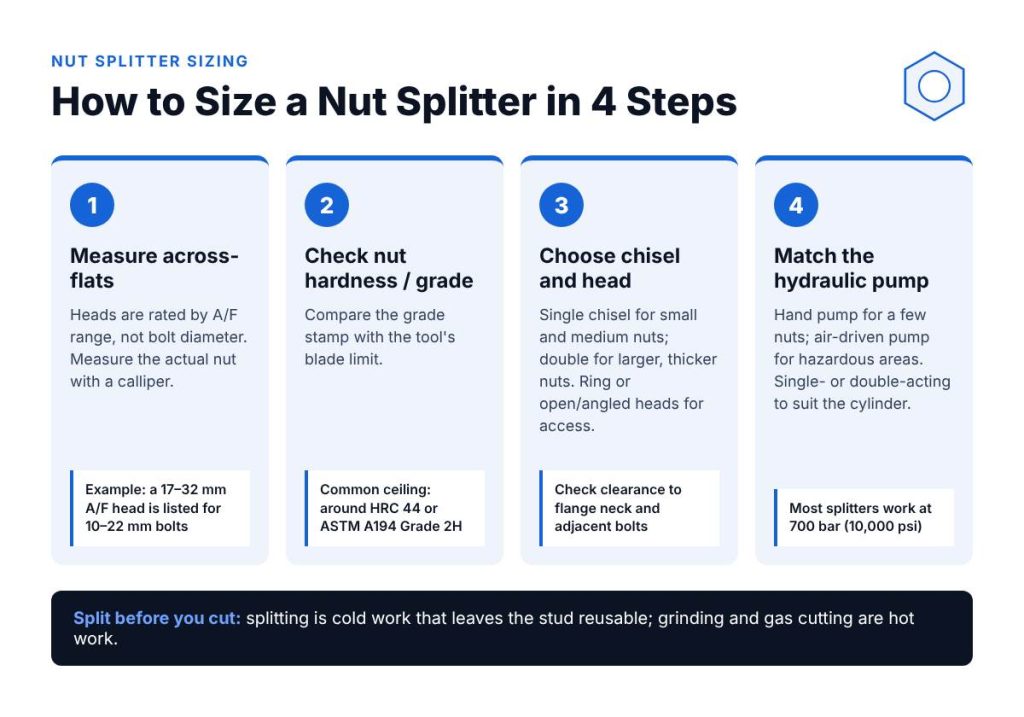
Start with the nut’s across-flats, because splitter heads are rated by A/F range, not bolt diameter. Measure the actual nut with a calliper, since corrosion and past repairs on marine and offshore yards often leave nuts that no longer match the drawing. As one example, a manufacturer’s head covering 17 to 32 mm A/F is listed for bolts of 10 to 22 mm.
Next, check the material. Several manufacturers publish a hardness ceiling for their blades, commonly around HRC 44, and some state it as nuts no harder than ASTM A194 Grade 2H, the heavy hex nut grade widely used with B7 studs on refinery flanges. For alloy or higher-strength nuts, check the grade stamp against the tool’s specification sheet first. On our Boltite BNS Series hydraulic nut splitter, the range is built around ANSI B16.5/BS 1560 flanges, with interchangeable heads to cover different nut sizes; ask us for the spec sheet to confirm the exact A/F range and hardness rating for your nuts.
Single or Double Chisel, and Which Head Should You Choose?
A single-chisel nut splitter tool cuts one flat at a time, which suits small and medium nuts and keeps the head slim. Double-cutting designs use two chisels working on opposite flats, which helps on larger, thicker nuts. The Boltite BNS uses what the maker calls tri-blade technology, three cutting surfaces on a single blade. Ring-type heads wrap around the nut for a stable grip; open or angled heads help where neighbouring bolts block access. Check clearance to the flange neck and adjacent bolts before you order.
Which Hydraulic Pump Do You Need for a Nut Splitter?
Most hydraulic nut splitters work at 700 bar (10,000 psi), so the hydraulic pump must deliver that pressure safely with a gauge you can read. A hand pump suits a few nuts in a remote spot; an air-driven pump suits hazardous areas. The Boltite BNS is offered with single-acting spring return or double-acting cylinders, and that choice decides whether a single-acting or double-acting pump fits. Our article on which hydraulic pump you need for bolting and flange work walks through the full selection.
When Should You Split a Nut Instead of Cutting or Burning It?
Split first whenever the nut is accessible and within the tool’s hardness limit, because it is cold work that leaves the stud reusable. Corrosion is the root cause behind most seized nuts, and it is costly: the NACE IMPACT study estimated the global cost of corrosion at US$2.5 trillion, roughly 3.4 percent of global GDP (reported in 2016, Inspectioneering).
Grinding, flame cutting and burning count as hot work. Singapore’s Workplace Safety and Health (Shipbuilding and Ship-Repairing) Regulations 2008 define hot work as including welding, flame cutting or burning and any work that produces heat or sparks. In a live refinery or a shipyard, that means a hot work permit, gas testing and a fire watch.
| Method | Hot Work? | Stud and Flange Risk | Best Used When |
|---|---|---|---|
| Hydraulic nut splitter | No (cold work) | Low, if blade depth is set correctly | Seized or corroded nuts within the tool’s A/F and hardness range |
| Grinding or disc cutting | Yes (sparks) | Medium to high: easy to nick threads or flange face | Nut too hard to split, area cleared for hot work |
| Gas torch | Yes | High: heat can affect stud and flange material | Last resort with full hot work controls and approval |
| Torque wrench breakout | No | Low to medium: overloading can gall threads or twist the stud | Nut is tight but not fused to the stud |
Torque breakout should come before splitting if there is a fair chance the nut will turn; our comparison of hydraulic torque wrenches and bolt tensioners explains which tool suits which joint. When the nut is clearly fused by rust, switch to the nut cracker tool.
“Hot work around flammable gas or vapor is one of the most common causes of worker deaths.” – William B. Wark, Board Member, US Chemical Safety Board (CSB), 2010
How Do You Protect the Stud and Flange When Splitting?
The key is controlling blade depth so the chisel stops before it reaches the stud threads. The Boltite BNS has a preset scale for controlled blade extension and an internal pressure relief valve for overload protection. Clean loose scale off the nut, seat the head square on a flat and build pressure steadily. After the split, spread the joint gently with a proper flange spreader tool instead of a wedge and hammer. Replace any damaged stud and reassemble to your site’s bolting procedure; many plants base theirs on ASME PCC-1, Guidelines for Pressure Boundary Bolted Flange Joint Assembly.