Sidebar Table of Contents: enable if theme supports
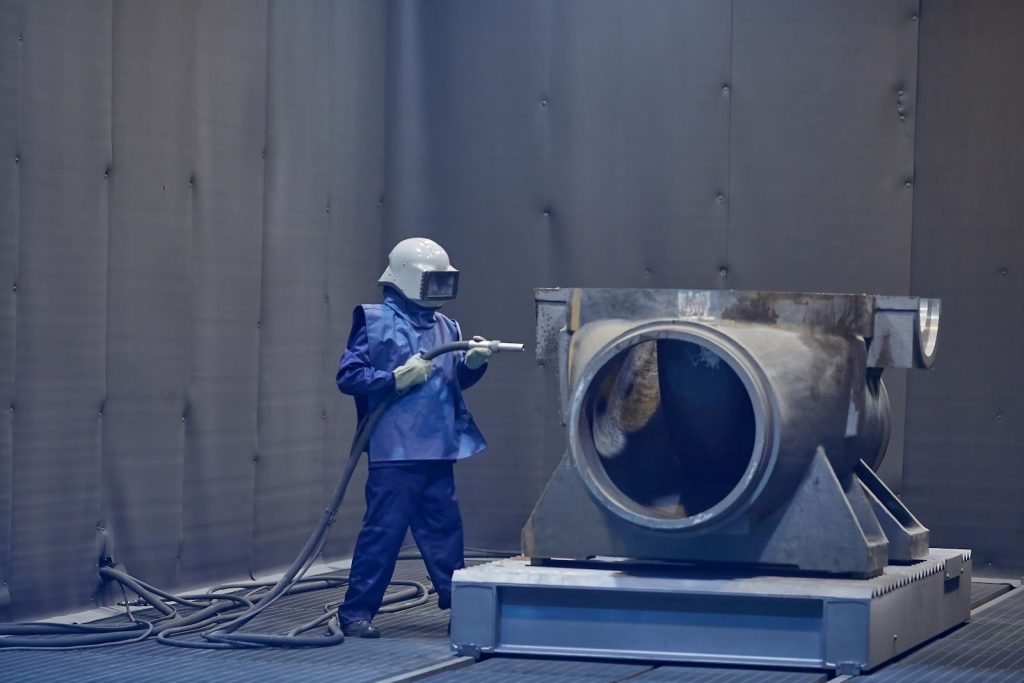
Dry ice blasting and glass bead blasting look alike from a distance: an operator, a hose, a nozzle and a stream of media hitting a dirty surface. Up close, they behave very differently, and the wrong pick shows up later as a scuffed mould, beads lodged in a gearbox, or a turnaround that overruns because half the plant had to be stripped down first. For a planner preparing a Jurong Island shutdown, the real question is what each method does to your equipment, schedule and site. This guide compares both side by side so you can choose with confidence.
What Is the Difference Between Dry Ice Blasting and Glass Bead Blasting?
The difference is what happens to the media after it hits the surface. In dry ice blasting, 3 mm pellets of solid CO2 at -78.5°C strike the contaminant, the sudden cold makes it brittle and shrink away from the substrate, and the pellets then sublimate straight into gas. Nothing is left to sweep up except the dirt itself, as our dry ice blasting guide explains in more detail. Glass bead blasting fires small spheres of soda-lime glass that clean by impact and peen the surface lightly, leaving what manufacturer Kramer Industries describes as a smooth, bright, satin-like finish on metals such as aluminium, steel and brass. The beads survive the blast and must be captured and eventually disposed of. In short, dry ice cleaning removes dirt only, while glass beads clean and refinish in a single pass.
| Factor | Dry Ice Blasting | Glass Bead Blasting |
| Media | Solid CO2 pellets, 1.5 to 2 Mohs | Soda-lime glass spheres |
| Effect on substrate | No material removed | Light peening, satin finish |
| Secondary waste | None; pellets turn to gas | Spent beads mixed with removed dirt |
| Disassembly needed | Usually cleaned in place | Parts often removed to a cabinet or enclosure |
| Water or residue | Dry, water-free, non-conductive | Dry, but fine beads can lodge in gaps |
| Main safety watch-point | CO2 build-up, noise, cold burns | Dust, rebound, media containment |
| Best for | Moulds, motors, heat-sensitive or live equipment | Finishing removable metal components |
Will Either Method Damage My Equipment?
Dry ice blasting is the gentler option because the pellets are soft and disappear on contact, so they do not remove substrate material. That makes dry ice cleaning a natural fit for tooling where tolerances matter, such as tyre and plastic moulds, printing rollers, food processing lines and electrical windings, where a dry, non-conductive medium is far safer than water. Glass bead blasting is gentle for an abrasive and is marketed for finishing without etching or changing part tolerances, yet it still works by impact. It alters surface texture, and beads can wedge into threads, bearings and seal grooves unless openings are masked. If the part must keep its original finish, or contains crevices you cannot easily flush out, lean towards dry ice.
How Much Downtime and Clean-Up Should I Expect?
Downtime usually favours dry ice blasting services because equipment can often be cleaned on site without dismantling, and in some cases while it is still running. In a turnaround, that means fewer hours unbolting and reassembling components. Glass bead work tends to happen in a blast cabinet or a tented enclosure, which adds handling time, plus a clean-up to recover stray beads afterwards. The hidden cost is waste. Spent media mixed with oil, scale or old coatings may count as toxic industrial waste, and the National Environment Agency requires such waste to be collected by an NEA-licensed collector. With dry ice, only the removed contaminant remains to be handled.
Is Dry Ice Blasting Safe in Confined Spaces in Singapore?
Yes, provided the CO2 is managed. Every kilogram of dry ice becomes gas that can displace oxygen in tanks, pits, vessels and poorly ventilated rooms. Singapore’s Workplace Safety and Health (General Provisions) Regulations set the permissible exposure level for carbon dioxide at 5,000 ppm over a working day and 30,000 ppm for short-term exposure. Above that, the risk rises quickly.
“The revised IDLH for carbon dioxide is 40,000 ppm based on acute inhalation toxicity data in humans.” US National Institute for Occupational Safety and Health (NIOSH).
Inside a confined space, the WSH (Confined Spaces) Regulations 2009, supported by the SS 568 code of practice, call for an entry permit, gas testing before entry and while work continues, and adequate ventilation. In practice, that means continuous CO2 and oxygen monitoring, forced extraction rather than relying on natural airflow, a standby attendant, and hearing and cold protection for the blaster. Glass bead blasting brings its own dust and containment duties, so both methods need WSH planning.
When Should I Choose Dry Ice Blasting Over Glass Bead Blasting?
Choose dry ice blasting when the equipment must stay in place, when it cannot get wet, when leftover media would cause trouble, or when the surface has to stay exactly as it is. Think moulds, motors, electrical panels, conveyors and food or pharmaceutical lines. Choose glass bead blasting when you want a consistent cosmetic finish on removable metal components and have a cabinet or enclosure to collect the media. Neither method is built for heavy hardened deposits inside tubes, where ultra high pressure water jetting is often the better tool. Looking at the whole job helps you match each asset to the right industrial cleaning method.
Quick Selection Checklist
- Cannot dismantle or move the equipment: dry ice
- Electrical, heat-sensitive or food-contact surfaces: dry ice
- Need a uniform satin finish on bare metal parts: glass beads
- Working in a tank, pit or enclosed room: dry ice with CO2 monitoring and forced ventilation
Frequently Asked Questions
Is dry ice blasting abrasive?
No. The pellets are soft (1.5 to 2 Mohs) and sublimate on impact, so they lift contaminants without removing substrate material.
Does glass bead blasting change part dimensions?
It is designed to clean and finish without etching, but it does change surface texture, so mask critical faces and openings.
Can dry ice cleaning be used on electrical equipment?
Yes. Dry ice is water-free and non-conductive, which suits motors, generators and control panels once correct isolation is in place.
Which method creates less waste?
Dry ice blasting. Only the removed contaminant remains, while glass bead blasting leaves spent beads that must be collected and disposed of.
How do I control CO2 when blasting indoors?
Use forced ventilation, monitor CO2 and oxygen continuously, and follow your confined space entry permit when working in tanks or pits.
Plan Your Next Industrial Cleaning Job with Petracarbon
Petracarbon’s dry ice blasting services help plants in Singapore clean equipment on site, across sectors from petrochemical and power generation to food, plastics and marine, and our full range of industrial cleaning services covers the jobs dry ice is not built for. Contact our team to talk through your equipment, site conditions and shutdown window.